Customer Service Tone of Voice: A Small-Team Guide
Create a practical customer service tone guide for your team and AI, with clear writing rules, example rewrites and a simple conversation-review process.
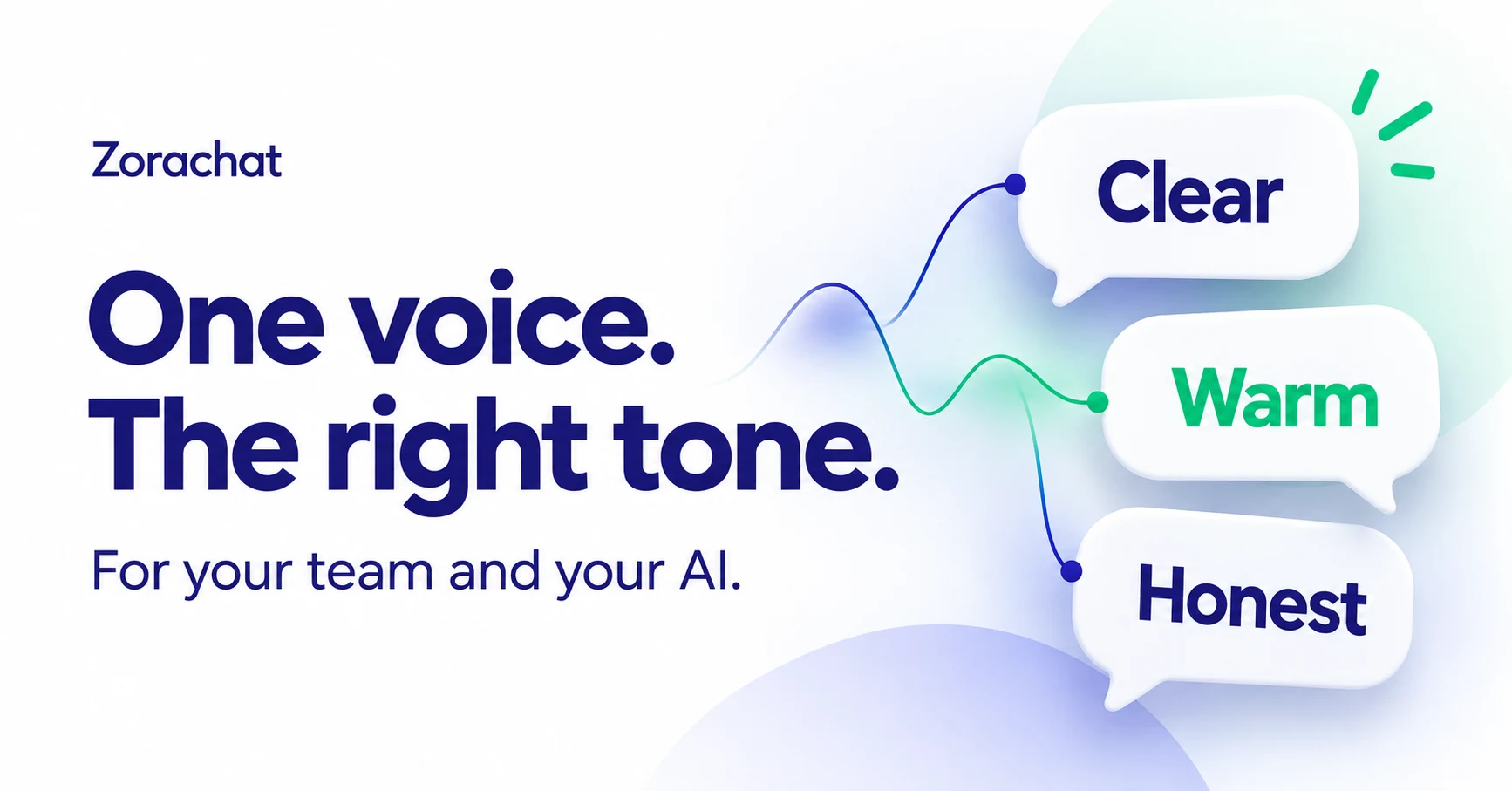
A useful customer service tone of voice makes replies clear, respectful and appropriate to the customer’s situation. To define yours, choose a few writing rules, show how they change between everyday questions and difficult conversations, and test the same examples with your team and AI assistant.
For a small business, this does not need to become a large branding project. One page can give everyone a shared starting point for WhatsApp, Instagram, Facebook Messenger and website chat. The aim is recognisable, helpful communication without making every answer sound copied.
What is customer service tone of voice?
In written support, tone comes through word choice, sentence length, punctuation, formality and what you choose to acknowledge. “Send your order number” and “Could you share your order number so I can check the delivery?” request the same detail, but give the customer different experiences.
It helps to separate the voice you want people to recognise from the tone a particular situation needs. Microsoft’s brand voice guide makes that distinction: its underlying voice stays consistent while the tone adapts to the context and the customer’s state of mind.
For your business, that might mean being straightforward and welcoming throughout, but dropping playful language when someone reports a problem. A consistent voice does not mean using the same cheerful greeting in every conversation.
1. Start with replies your team already sends
Choose a small sample of recent conversations: a product question, an unclear enquiry, a delayed response, a complaint and a request for a person. Remove identifying details before using them as training examples outside their original working context.
Read the replies together and ask three questions:
- Can the customer find the answer or next step quickly?
- Does the wording acknowledge what they actually said?
- Does the reply sound more certain than the facts allow?
Look for specific differences rather than voting on whether a reply feels “professional”. One teammate may write long introductions, another may use unexplained abbreviations, and an assistant may add enthusiasm to every answer. Those are behaviours you can address in a guide.
2. Write a one-page customer service tone guide
Choose rules that someone can apply while answering a real message. “Be friendly” is too broad on its own. “Acknowledge the question, answer it, then offer one relevant next step” provides a usable structure.
The following is an illustrative starting point for a small business, not a required Zorachat preset:
| Principle | Writing rule | Check before sending |
|---|---|---|
| Clear | Put the answer before the background explanation. | Can the customer identify the main point in the first sentence? |
| Considerate | Use details the customer has already supplied. | Are we asking them to repeat something? |
| Honest | Separate confirmed information from what needs checking. | Have we turned an assumption into a promise? |
| Approachable | Use familiar words and short paragraphs. | Would the wording make sense outside our team? |
| Calm | Use restrained punctuation; avoid jokes in complaints. | Does the energy of the reply fit the situation? |
| Useful | Explain the purpose of any question or next action. | Does the customer know why we need the detail? |
Add your actual choices about greetings, contractions, emoji and terminology. For an international audience, prefer plain wording over local slang or idioms. Keep official product names and policy terms accurate even when the surrounding language is informal.
3. Adapt the tone to the situation
These fictional examples show editorial choices. They are not customer testimonials or instructions to promise actions your team cannot perform.
A routine product question
Less useful: “Greetings! We are delighted to receive your valued enquiry regarding our collection.”
Clearer: “The size guide is on this product page: [relevant link]. Which measurement would you like help with?”
The second version helps before adding ceremony. Use the link only when it exists and is relevant. For more situations to adapt, see the customer service response templates.
A frustrated customer
Less useful: “No worries! Let’s get this sorted 😊”
More appropriate: “I’m sorry you have had to contact us again about the delivery. Could you share [required reference] so our team can check what happened?”
The revised reply names the issue and explains the request. It does not assume the problem is easy or suggest that a resolution has already been arranged.
An answer that still needs checking
Less useful: “That should be fine.”
More precise: “I do not have confirmation that this option is available. Our team needs to check it before you make plans around it.”
If a real follow-up action is available, explain it. Otherwise give the actual contact route. Warm language should not hide uncertainty.
A customer asks for a person
Less useful: “Before I transfer you, please answer a few more questions.”
More respectful: “Of course. [Accurate handoff or contact information]. You have already explained [brief context].”
Replace the brackets with what can actually happen. Do not say someone has joined until they have. Tone guidance should support your rules for bringing in a person, rather than keep customers in a conversation they want to leave.
4. Keep style rules separate from business facts
Your tone guide describes how to communicate. Your product information and policies establish what can be said. Keep both current, but review them separately.
For example, “Use a reassuring tone” must not turn “We will check availability” into “Your item is reserved”. Similarly, rewriting a returns explanation should not change the eligibility conditions or omit an important limitation.
When a reply sounds awkward, first check whether the source answer is incomplete. Polishing the sentence will not fix a missing delivery policy. Give the team a clear owner for updating facts and a separate way to suggest wording improvements.
5. Give your AI concrete guidance and examples
A practical instruction could be:
Answer the customer’s specific question first. Use short paragraphs and familiar words. Acknowledge frustration without jokes or emoji. Do not add prices, availability, deadlines or actions that the approved information does not confirm. Ask one relevant clarification at a time. Follow the agreed human-handoff process when a person is needed.
This is a suggested instruction to adapt and test, not a guarantee of any assistant’s behaviour. Add examples of acceptable wording alongside the rules, and keep them free of outdated business facts.
Zorachat can learn from website content, PDFs, FAQs and written instructions, and its business-training feature supports tuning the assistant’s tone. Use your guide alongside those sources, then review the actual answers. Do not assume uploading a guide makes every future response appropriate.
6. Run a short tone review before expanding
Test a fixed set of scenarios with a teammate and your assistant: a simple question, missing information, an upset customer, an unsupported request and a request for human help. Include a customer who writes briefly or without punctuation; that alone is not a reason to assume they are angry.
For each reply, check factual accuracy first, then relevance, tone and the next step. If you rewrite an answer to sound warmer, compare the factual meaning before and after. Review complete conversations as well as isolated messages: repeated greetings and apologies can become distracting even when each sentence looks polite.
Repeat this small review when policies, staffing or instructions change. Keep the examples that expose a real problem, rather than expanding the guide with rules nobody uses.
Put one guide to work across your conversations
Your channel may change the length of a reply, but it should not change the underlying facts or respect shown to the customer. Start with a manageable set of examples that your team can explain and your assistant can be tested against.
Build your Zorachat assistant with approved business information and your tone guide, then review the replies alongside the people who handle your customer conversations.