Customer Service Quality Assurance Checklist for Small Teams
Use this customer service QA checklist to review AI and human chats, record evidence, catch unsupported promises and turn findings into practical fixes.
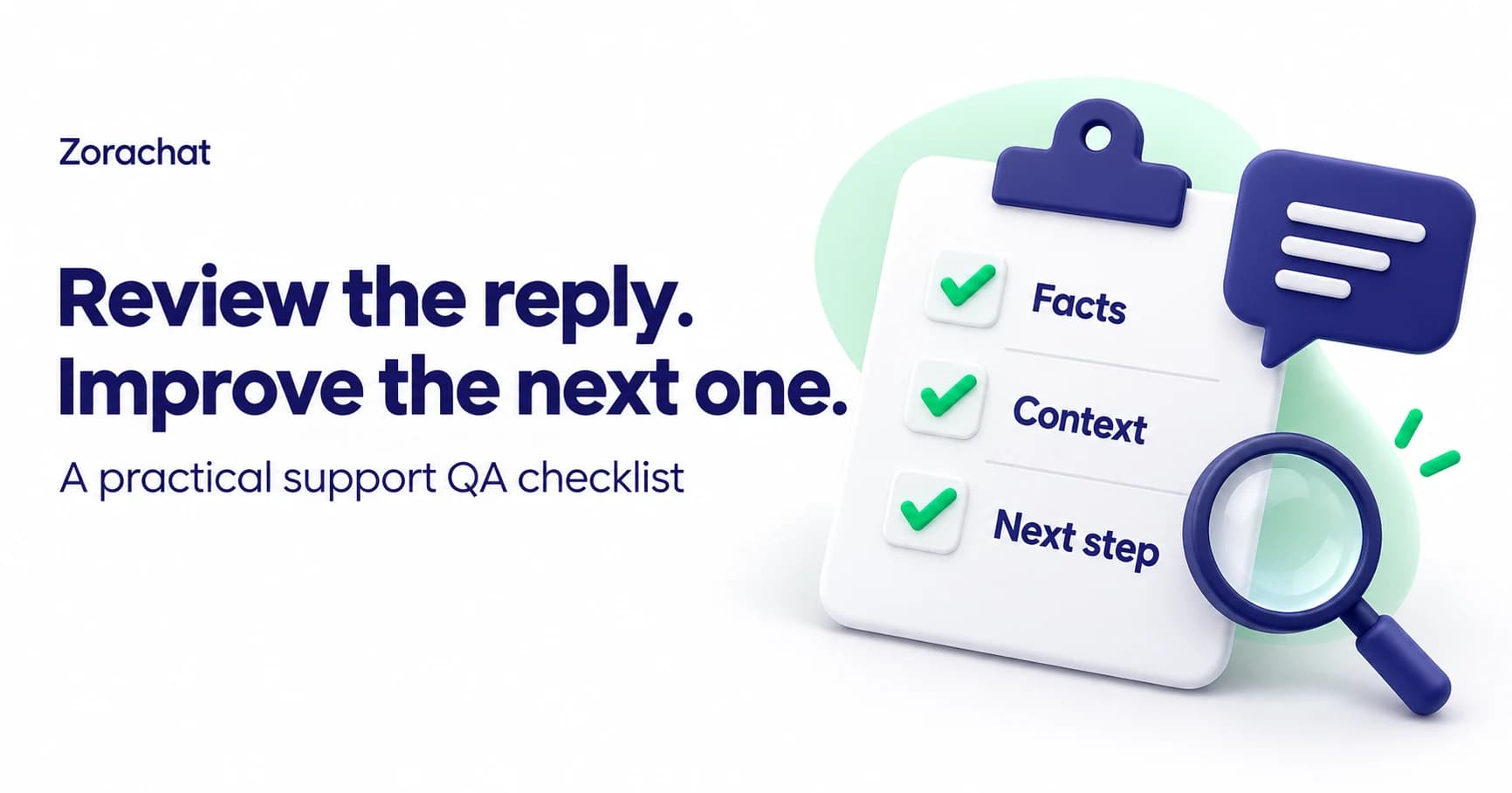
A customer service quality assurance checklist helps you review whether a conversation gave the customer an accurate, relevant answer and a clear next step. Start with a small sample of real chats, record evidence for each check, and assign a practical fix when something falls short.
This guide provides a manual review process for small teams using AI and human support across website chat, WhatsApp, Instagram and Facebook Messenger. You can run it in an access-controlled document or worksheet. The checklist is a suggested working practice, not a built-in Zorachat scoring feature.
Review the conversation, not just the last reply
A polished final message can hide an earlier wrong answer, repeated questions or a missed request for a person. Read from the customer’s first question through the latest meaningful action. For an unresolved case, assess what has happened so far without calling it a successful resolution.
Zendesk describes a QA scorecard as an evaluation form with rating categories for reviewing customer conversations. You do not need specialist scoring software to define useful checks for your own team.
Keep internal quality review separate from customer feedback. A customer may like the tone of an answer that contains an unsupported promise. Conversely, a correct explanation of an unwelcome policy may not receive a positive reaction. Read both kinds of evidence rather than treating either as the whole picture.
1. Choose a sample you can review consistently
Set a weekly review time and choose a number of conversations that fits your team’s capacity. Five chats can be a practical starting exercise for a very small team, but it is not a statistically representative audit or a universal target.
Use two separate groups:
- A routine sample: select conversations using a repeatable method, such as a random selection from the week, so you do not only inspect memorable problems.
- Flagged cases: review complaints, unsupported answers, failed handoffs and missed commitments that need investigation regardless of sampling.
Include AI-only, human-only and mixed conversations where they occur. Rotate through the channels and question types you actually handle. Keep the routine sample’s findings separate from the flagged cases; combining them into one headline failure rate would misrepresent how the chats were selected.
2. Use this customer service quality assurance checklist
For each row, mark Meets, Needs work or Not assessable. Add the message or approved source that explains your decision. “Not assessable” means the evidence is missing or the criterion does not apply; it should not silently count as a pass.
| Check | What good looks like | Evidence to record |
|---|---|---|
| Facts and limits | The answer matches the relevant approved information and makes uncertainty clear. | Source, applicable conditions and any unsupported statement. |
| Understanding | The reply addresses the actual question and uses details already supplied. | The customer’s request and the sentence that answers it. |
| Communication | The wording is readable, respectful and appropriate to the situation. | A specific example of useful or confusing wording. |
| Next action and ownership | The customer knows what happens next; any promised team action has an owner. | Agreed action, responsible person and realistic update point. |
| Boundaries and handoff | Requests needing a person follow the agreed process, with relevant context available. | The trigger, action taken and whether someone actually picked it up. |
Use current sources to judge a new answer. When reviewing an older conversation, also establish which policy or product information applied at the time. A policy changed yesterday should not automatically make last week’s correct answer a mistake.
For communication checks, use your customer service tone of voice guide. Avoid scoring based on whether the reviewer personally prefers a greeting or emoji.
3. Handle serious errors before calculating scores
A useful review should make consequential problems visible. A friendly reply that invents a delivery date needs attention even if its other qualities are strong. Do not let an average score hide the issue.
Agree which findings require immediate review by a responsible person. Examples might include an unapproved price, a false claim that an action has been completed, or a customer request for a person that went unanswered. The response depends on the case: correct the source, review the live conversation or arrange an appropriate customer update.
Record the issue, who is checking it and the next action. Avoid inventing a compensation or refund decision while correcting the wording. Your chatbot escalation rules should establish when human judgment is needed.
4. Work through one example together
Consider this fictional website-chat exchange:
Customer: “Can you deliver this to Bristol by Friday?”
Reply: “Absolutely! We deliver throughout the UK. Order today and it will arrive by Friday.”
Suppose the approved information confirms the delivery area but gives no guaranteed arrival date. The reply partially understands the request, but fails the facts-and-limits check: UK coverage does not establish arrival by Friday.
A more appropriate response would be:
“Bristol is within our delivery area. I cannot confirm arrival by Friday from the information available here. [Actual process for checking delivery options].”
Replace the brackets with a real next step. If the business has a checkout estimate, link to it; if a person must check, use the actual handoff route. Neither the original nor the revised example represents a Zorachat delivery service.
The improvement task is more specific than “make the AI less confident”: clarify the difference between coverage and arrival estimates in the source material, add a relevant instruction, and test deadline questions again.
5. Compare reviewer decisions before comparing people
Ask two teammates to review the same conversation independently, then discuss differences. One may mark a handoff complete because the assistant announced it; another may look for evidence that a person accepted the conversation.
Resolve that disagreement by improving the criterion. For example: “A transfer announcement alone does not prove that the next action was owned.” Record the agreed interpretation with an example so the next review uses the same standard.
For a solo founder, revisit a previous review after a short interval and check whether the evidence still supports the decision. Use the exercise to make the checklist clearer, not to create an artificial league table from a handful of chats.
6. Turn each finding into a small improvement task
Separate the cause from the person or assistant that sent the reply. A confusing answer might come from an outdated policy, unclear responsibility, missing knowledge or a wording choice.
- Knowledge issue: update the authoritative source and test the affected questions.
- Instruction issue: clarify the boundary and test both ordinary and exception cases.
- Team process issue: agree who owns the next action and when it will be checked.
- Writing issue: improve an example reply and explain the reason for the change.
Assign an owner, a review date and a check that will show whether the fix worked. The guide to improving chatbot accuracy covers source and answer testing in more depth. Recheck affected conversations as well as fresh test questions when a correction could change the customer’s next step.
Keep the review record useful
Record the conversation reference, channel, reviewer, checklist outcome, evidence and improvement task. Link to the original thread instead of copying unnecessary personal information into another document. Keep access appropriate to the people doing the work.
After several review cycles, look for repeated findings and unfinished fixes. State the number and selection method behind any result you report. A drop in errors among five chosen conversations is a useful observation, not proof that every customer experience improved.
Zorachat brings customer conversations into a shared inbox, with AI answers based on business information and human takeover when needed. Your team still owns the review standards and follow-through described here.
Build your Zorachat assistant around approved answers, then use a regular conversation review to decide what to improve next.