Customer Service Shift Handover Checklist for Small Teams
Keep unfinished customer conversations moving between shifts with a practical handover checklist, clear ownership, checked commitments and a worked example.
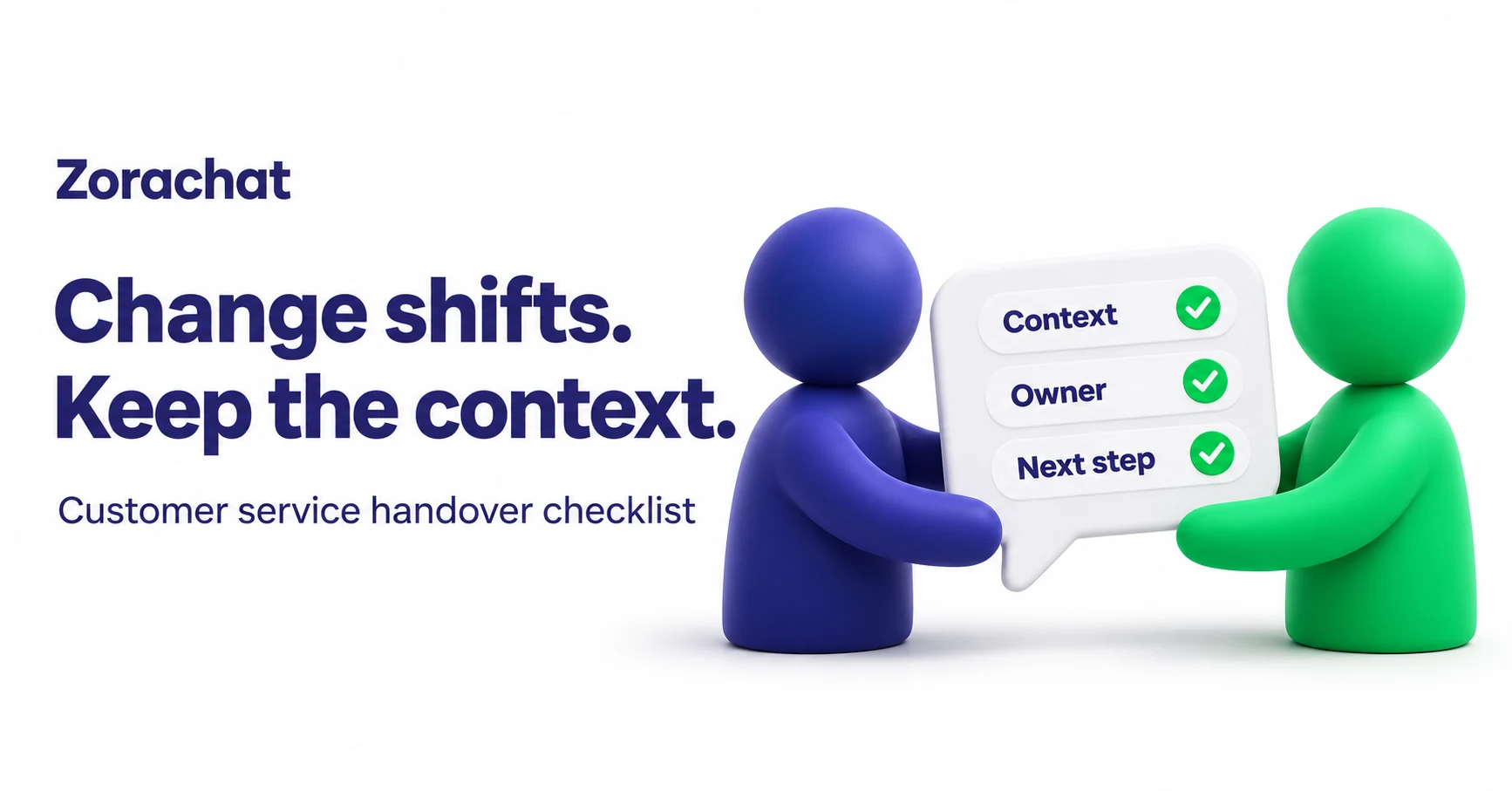
A customer service shift handover checklist should identify unfinished conversations, the promises already made, the next action and the person accepting responsibility. Before the outgoing teammate finishes, the incoming teammate should be able to find each important thread and explain what they will do next.
This guide is for small businesses covering website chat, WhatsApp, Instagram and Facebook Messenger. A shift change might mean a formal rota, a founder leaving the shop or one colleague covering lunch. The process below is a suggested team practice; it does not assume your software automatically assigns work, creates reminders or transfers responsibility.
What changes hands at a shift handover?
The important transfer is responsibility for unfinished work. Access to an inbox is only part of that. A colleague can see every message and still miss a promise buried halfway through a conversation.
Separate this from an AI-to-human handoff. That transition brings a person into a conversation the assistant was handling. A shift handover changes which teammate is responsible for the next action, sometimes long after a person first joined. For the former, see our guide to taking over an AI conversation.
Use one test: can the incoming teammate continue without asking either the customer or the outgoing colleague to reconstruct the case? If not, the handover needs a clearer reference, a missing fact or an explicit decision.
1. Identify the work that crosses the coverage boundary
Review open conversations before the changeover. Include threads waiting for customer information, an external answer or an internal decision. A message saying “we are checking” does not make the underlying request complete.
Give particular attention to:
- Updates promised during the incoming teammate’s coverage.
- Questions that require a decision from someone else.
- Customers who have returned because an earlier answer did not solve the issue.
- Cases with conflicting information or a draft response still being checked.
- Conversations where a person has taken over and work remains unfinished.
Do not copy every closed conversation into a separate document. Keep the handover focused on work that needs attention, while preserving access to the original records. If the volume is too large to review properly, use the prioritisation method in our customer support backlog guide.
2. Use a short, actionable handover record
Keep the record in an approved place your incoming colleague can access. That might be a maintained team worksheet or a suitable internal record in your existing system. Do not paste internal commentary into a customer-facing reply.
| Field | What to record |
|---|---|
| Conversation reference | The channel and a reliable way to open the original thread. |
| Customer’s unresolved need | The question or outcome that still requires work. |
| Checked facts | What has been confirmed and what remains uncertain. |
| Last customer update | What was actually sent, including any commitment. |
| Next action | A specific task, its dependency and the person responsible. |
| Next review or update | The agreed date, time and time zone, where relevant. |
| Acceptance | Who has accepted the work and any remaining question. |
Summarise the decision-relevant facts rather than rewriting the transcript. Reference the original conversation for detail. Include only information needed to continue the work, and avoid copying sensitive customer material into informal personal messages.
3. Distinguish a sent update from a draft
A common source of confusion is a message that someone prepared but never sent. Write “draft awaiting confirmation” when that is the state. Do not record its proposed promise as though the customer has received it.
The incoming teammate should check the latest actual outbound message before replying. A customer may also have sent new information after the handover note was written. Treat the note as a guide to the thread, not a replacement for reading its latest state.
If two people could reply during an overlap, agree who sends the next message. One person can investigate while another communicates, but those roles should be explicit. “We are both watching it” leaves room for duplicate or contradictory replies.
4. Make the next action concrete: a worked example
Consider a fictional home-services business. A customer asks whether an installation can include an unusual wall fitting. The morning teammate has explained the standard service and requested a photo. The photo has arrived, but the installer has not confirmed feasibility.
A weak note says: “Installation question. Waiting on installer.” A more useful record says:
Website conversation [reference]. Customer wants to know whether the pictured wall fitting is suitable. Standard service explained; photo received. Suitability is unconfirmed. Last message sent: we will update them by 15:00 UK time on Thursday 5 November. Sam will ask the installer to review the photo and send the update. If no answer is available, Sam will explain that checking is still in progress. No appointment or extra charge has been agreed.
This is an illustrative workflow, not a customer result or an automated Zorachat action. Its strength is that the incoming teammate knows what is uncertain, what the customer expects and what must happen next.
Only make an update commitment that someone can meet. An internal target to obtain an answer is different from a confirmed installation date. Keep those distinctions visible when the case moves between people.
5. Ask the incoming teammate to accept the work
A sent handover message does not show that anyone has read it. For important unfinished cases, ask the incoming teammate to confirm the next action and highlight missing information.
A short acknowledgement is enough: “I have the thread. I will check with the installer and send the agreed update.” If they lack access or cannot meet the commitment, resolve that gap before the outgoing teammate leaves where possible.
When nobody is available to take over, keep responsibility with a named person and arrange a realistic review point. Tell the customer the actual availability when an update is needed. Do not imply a colleague is joining immediately if coverage has ended.
6. Use shared visibility without assuming automatic ownership
Zorachat provides a unified inbox for website chat, WhatsApp, Instagram and Facebook Messenger, alongside AI replies and human takeover. Its Live Agent app lets teammates follow conversations and step in from a phone as well as the web.
Those capabilities help a teammate access the conversation history. Your rota, acceptance check and handover record still need a team process. Do not assume opening a thread assigns it, that a notification confirms someone has accepted it, or that a human decision has been completed because the assistant replied.
If a customer contacts two channels, verify the context before linking those requests in your working record. Similar display names do not establish identity, and shared inbox access does not mean separate threads or identities automatically merge.
Customer service shift handover checklist
Before finishing coverage, confirm these points:
- Important unresolved conversations are listed with usable references.
- Sent messages, drafts and unconfirmed decisions are clearly distinguished.
- Customer commitments include a clear date and time where needed.
- Each next action has a named owner and a review point.
- The incoming teammate can access the relevant history.
- Responsibility has been accepted, or a coverage gap has been addressed.
- The latest thread has been checked before anyone sends a new reply.
After a few changeovers, review any missed updates, duplicate replies or cases requiring reconstruction. Change the handover format when a field repeatedly proves unclear. The goal is continuity of useful help, not a longer document.
Build your Zorachat assistant for routine questions, then pair shared conversation visibility with a handover process your team can reliably follow.