How to Handle Quote Requests in Customer Chat
Turn vague price enquiries into useful quote requests with a clear chat intake, relevant questions, honest expectations and a handoff to the right person.
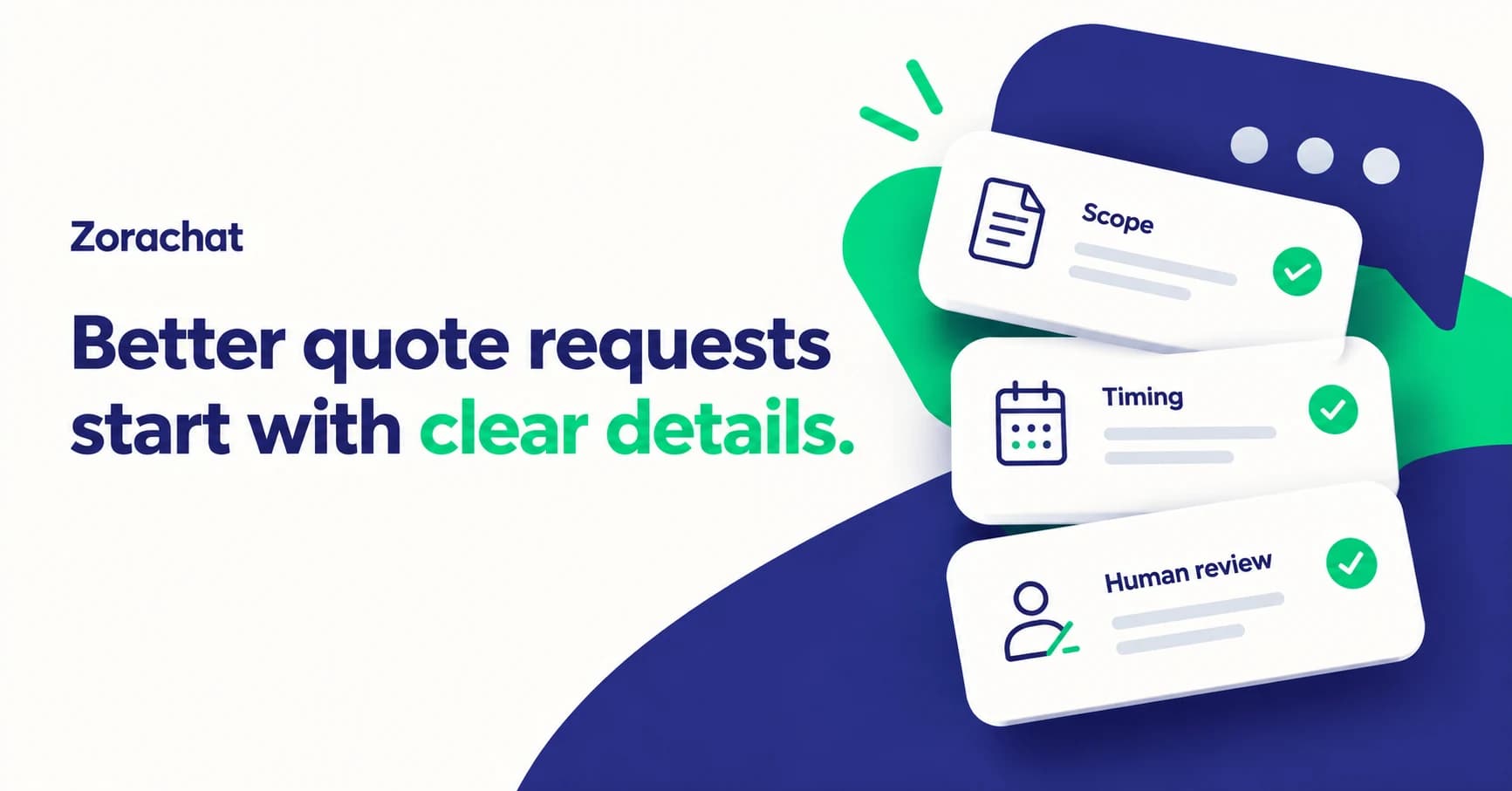
Here is how to handle quote requests in chat: acknowledge the work the customer wants, collect the details that change the price, and pass a clear brief to the person responsible for quoting. Share an approved standard price when it genuinely applies; keep custom prices and availability unconfirmed until someone has checked them.
For a small service business, “How much would this cost?” can arrive through WhatsApp, Instagram, Facebook Messenger or website chat. The immediate goal is to help the customer reach a reliable answer without making them complete an interview or treating an incomplete request as a confirmed booking.
Separate the enquiry from the pricing decision
A useful first response does not always contain a number. It should establish whether you understand the request and what is needed next. A published package price may answer a straightforward question. A custom project may require measurements, a conversation or a site visit.
Business Queensland’s guide to preparing a quote recommends understanding the requested scope and checking resources and availability before quoting. Apply that practical principle to your intake process: establish what the customer needs before presenting a price as settled.
This guide covers conversation handling, not quote terms or contract drafting. The workflow, examples and tracker below are recommended team practices; they are not a claim that Zorachat automatically calculates prices, creates quotes or confirms appointments.
1. Acknowledge the actual request
Read the message before asking questions. If someone has already described the service, location and deadline, use those details instead of asking them to start again.
Thanks for asking about an end-of-tenancy clean for your two-bedroom flat. Is it furnished or unfurnished? That helps our team check the scope before preparing a price.
This is a fictional cleaning-business example. It recognises the information already supplied, asks one relevant question and explains why it matters. Avoid “Please provide more details” when you can name the specific detail you need.
If you do not provide the requested service, say so early. A polite explanation is more useful than collecting contact details for work your business cannot undertake.
2. Collect a minimum brief for the next decision
Build a short intake checklist for each service. Ask only what changes whether you can help, who should review the request or what they need to prepare an answer.
| Detail | Useful question | Reason to ask |
|---|---|---|
| Scope | What work would you like included? | Distinguishes the requested service from optional extras. |
| Size or quantity | How many rooms, items or deliverables are involved? | Gives the reviewer a usable starting point. |
| Location or delivery format | Which area is the job in, or will the work be remote? | Checks service fit without immediately requesting a full address. |
| Timing | When do you need the work completed? | Identifies the deadline without promising availability. |
| Next contact | Where would you like the team to send their reply? | Supports the requested follow-up. |
Adapt the questions. A design agency may need the intended audience and deliverables; a cleaning business may need property size and condition. Do not ask both sets of questions by default. For broader examples, use the guide to relevant qualification questions for chat.
Let customers say “I’m not sure”. Missing information can be a reason for a human conversation rather than an endless clarification loop. Avoid requesting passwords, payment-card details or unrelated personal information in the brief.
3. Give an honest answer when the customer wants a price now
Do not hide approved public pricing behind unnecessary questions. If the service has a current standard price and the request meets its conditions, explain what is included and link to the relevant information.
When it does not fit a standard package, be specific about the uncertainty:
Our team needs to check the scope before confirming a price for this job. Does the request include the oven and carpets, or just the main rooms?
Only share a starting price or range if the business has approved it for that situation. Label it accurately and explain what still needs checking. Do not calculate a custom amount from incomplete information or copy a price from an unrelated example.
A requested date also remains a request until availability is checked. “I’ve noted your preferred Friday” communicates something different from “You’re booked for Friday”. Train your responses to preserve that distinction.
4. Hand over a brief a person can act on
Assign the request to a named person or clearly defined team in your own working process. Their first action might be preparing a quote, arranging a scoping call or asking one remaining question.
A simple manual handoff record could look like this:
- Request: end-of-tenancy clean, two-bedroom unfurnished flat.
- Scope discussed: oven included; carpets not yet confirmed.
- Timing requested: Friday; availability not confirmed.
- Price discussed: no custom price supplied.
- Next action: assigned reviewer to clarify carpets and check capacity.
- Contact and source: agreed reply channel and original conversation link.
This fictional record is a suggested checklist, not an automatic Zorachat export. With Zorachat’s human handoff, a teammate can take over the same conversation with its history. They should read that history before asking the customer to repeat information.
5. Set a next step your team can honour
An acknowledgement should say what happens next. Give a response time only if someone owns it and has capacity to meet it. Include the time zone when the customer and team may be in different countries.
Thanks, that gives us the main details. Our team still needs to check [specific point] before confirming the price. Would you prefer the reply here or by email?
If the team is offline, explain that the request will be reviewed when they return. Do not imply a person is currently preparing a quote unless that is true. Keep the original channel visible even if the customer requests a different reply method; do not assume separate channel identities merge automatically.
After a quote is sent, follow up in the context of the request. Ask whether the customer needs clarification or a scope change, rather than repeatedly asking for a decision. Keep follow-up timing in your team’s tracker and respect a request to stop.
6. Give the AI useful information and clear boundaries
Prepare approved information about your services, areas covered, standard inclusions, exclusions and the details needed for custom work. Include examples where the assistant should answer directly and examples where it should bring in a person.
Zorachat can use business information to answer routine questions across website chat, WhatsApp, Instagram and Facebook Messenger. Its conversational lead capture collects contact details and intent for your team’s follow-up. Pricing approval and any appointment or quotation process remain your responsibility.
Before using the workflow, test a vague enquiry, a complete request, an unsupported service, a changed scope and a request for a person. Check that the assistant uses supplied details, avoids invented prices and makes no unconfirmed promises.
Review whether requests become easier to answer
Each week, sample a few quote enquiries. Count how many had enough information for the next action, how often customers had to repeat themselves and how many promised replies were missed. A completed intake is not a sale, and a captured email is not a delivered quote.
If reviewers keep asking the same missing question, improve the intake checklist. If customers abandon it, remove questions that do not affect the next decision. Start with one service, refine the conversation, and build your Zorachat assistant around that tested workflow.